

Written by Colin Ma
Quick Navigation
How Should a Suit Fit: Quick Reference
| Part | How It Should Fit | Common Problem |
|---|---|---|
| Jacket shoulders | Seam sits exactly at edge of shoulder — no droop, no pull | Seam hanging over arm = too wide |
| Jacket length | Bottom at knuckle level / mid-crotch — rear partially covered | Too long shortens legs visually |
| Jacket chest | Slight hug — hand slides under lapel without pulling | X-shape pulling = too tight |
| Jacket sleeves | ½ inch of dress shirt cuff visible below jacket sleeve | No cuff showing = sleeves too long |
| Jacket collar | Touches shirt collar with no gap or bunching | Gap between collars = shoulders too wide |
| Trouser waist | Sits at upper hip — secure without a belt | Sitting at hip like jeans = too low |
| Trouser thighs | ~1 inch of extra fabric each side — tailored not tight | Pulling across thigh = too narrow |
| Trouser break | Slight or no break — full break looks sloppy | Fabric pooling at ankle = too long |
In the realm of men's fashion, few garments exude timeless elegance and sophistication quite like the classic suit. The art of dressing well lies not only in selecting the right ensemble but also in ensuring a perfect fit.
The suit jacket and pants, the backbone of any formal or professional attire, should be tailored to precision to accentuate the wearer's physique and to look and dress better.
In this guide, we delve into the principles of fit, offering valuable insights on how your suit jacket and pants should ideally drape your frame. Additionally, we explore some essential dress advice and provide a brief historical overview, unveiling the sartorial journey that has made the men's suit and these top suit brands an enduring symbol of refined style.
The men's suit originated in Western Europe in the 17th century. It evolved from the matching "ditto suit" of the late 17th century to the three-piece suit in the 18th century, with improved tailoring and the use of structured cuts and fabrics. In the 19th century, trousers replaced breeches, and the lounge suit emerged as a less formal option.
The 20th century brought further style shifts and the introduction of ready-to-wear suits. Today, the men's suit remains a symbol of elegance and professionalism in fashion.
Although they’re a classic, tuxedos and suits still have some design changes depending on what the current trend is. For a lot of guys, that can make it harder to find a suit that fits and feels good.
You don’t want to look sloppy with a baggy suit, but you also don’t want to look like you’re squeezing into your suit either. Trust us, there is a perfect fit for every guy out there, but you have to know what to look for.
How Should a Suit Jacket Fit?
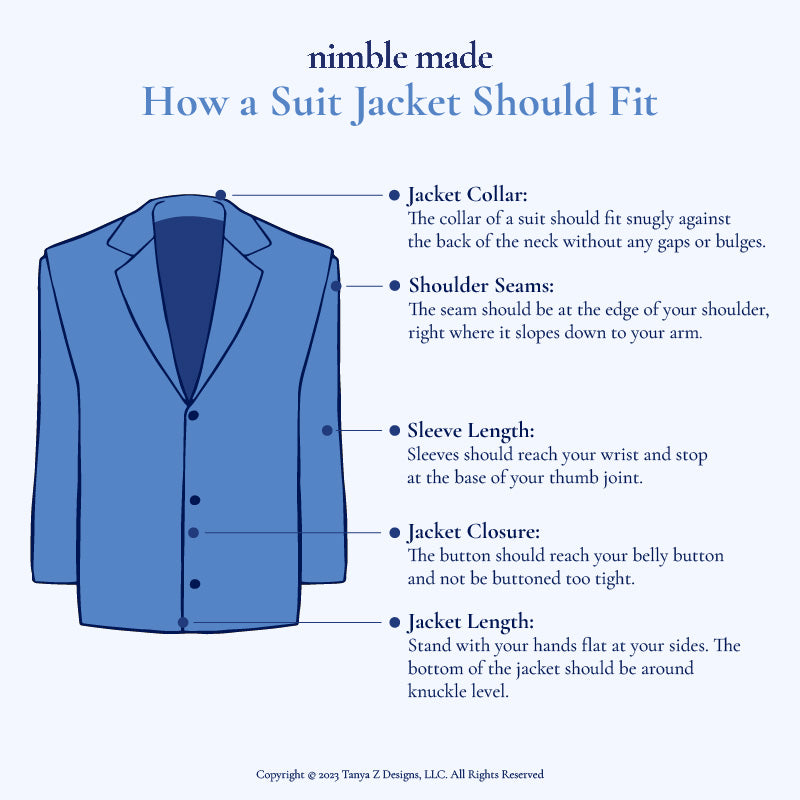
1. Overall Suit Jacket Length
Jacket length often seems like the hardest part of deciding how a suit jacket should fit. You don’t want the suit jacket length to be too long, that throws off your natural proportions. Nor do you want it too small, which causes the same issue. There are two ways to check to check your jacket length.
First, you can stand with your hands flat at your sides. The bottom of the jacket should be around knuckle level. The other method is making sure the bottom of the jackets falls to just about mid crotch.
Guys with a little less height may want to end their jacket right at mid crotch to even out their proportions. As a classic rule of thumb, suits should give you a little coverage behind too. Check and make sure your rear is at least partially (or mostly) covered by the back of the suit jacket.
2. Jacket Shoulder and Shoulder Seams
One of the most important things to look at with the shoulders of a suit is where the seam is. The seam that connects the shoulders to the arms of the jacket is a reliable indicator for fit. Basically, the seam should be at the edge of your shoulder, right where it slopes down to your arm. Here's a separate guide on how to measure your shoulder width.
The shoulders on a suit should be flat and smooth. You don’t want any rumpled fabric or creases. While there are a lot of things tailors can fix to make your suit fit better, shoulders are tricky. Because it’s not an easy or cheap process to fix shoulders, it’s better to make sure they fit, and tailor other parts instead.

3. Arms
When we talk about arms in suits, we’re not talking so much about the jacket sleeve as we are the actual armholes or circumference of the garment by the armpits. Naturally, you don’t want them too high or tight. Suits may not be the most comfortable jacket, but it shouldn’t pinch you either.
Your jacket sleeves length should be at the bottom of your wrist, closer to your shoulders and expose your dress shirt a bit.

Measuring from your armpit to the bottom of the arm hole, you should have a little space, but not too much. Stay away from suits with arm holes that extend down two or three inches. It’ll make the rest of the suit look less tailors, and bunch or sag.
You shouldn’t be able to feel the bottom of the armhole against your armpit. Basically, look for just enough space to be comfortable, but be careful of giving yourself too much extra room.
4. Upper Body & Torso Fit
The body of the suit is just as important as the length. Remember, nobody wants to be either stuffed or swimming in a nice suit. A more fitted suit flatters anyone, as long as you do it right. You should be able to feel the suit jacket slightly ‘hugging’ your torso, but lightly is the keyword here.

Fasten the middle or upper button to test out the fit. If you’re seeing the suit flare out near the top and bottom, it’s too tight. The suit creates a sort of X shape extending out from the button.
It’s far easier to take a jacket in than let it out, so it’s better to find a slightly larger body. You should also be able to slip your hand under either lapel without much pull back.
5. Jacket Sleeves
The first way to check sleeve length opts for a somewhat longer sleeve. Stand with your arms at your side, and see where the jacket sleeve falls. Ideally, the sleeves should reach where your wrist and the very base of your thumb joint. Here's also a helpful step-by-step guide for how to measure sleeve length.
The next way to find the perfect jacket sleeve length is similar, but you’ll end up with shorter sleeves. Stand with your arms at your side, and palms horizontal (facing the floor). The sleeve should sit about a quarter of an inch above your hand. This fit is especially popular with watch wearers, and guys that like to let a glimpse of their dress shirt show, depending on the sleeve length of the underlying shirt.

6. Jacket Closure & Button Position
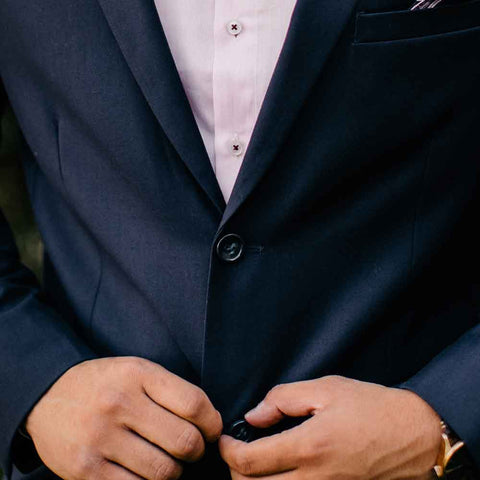
With a three button suit, you’ll always have the middle one buttoned, and sometimes the top or bottom depending on the occasion. With a two button suit, you button the top one, but very rarely the bottom one. Those rules are pretty simple, but what about where the buttons are positioned?
For two button suits or jackets, we’re referring to the top button. For three button jackets, we’re referring to the middle button. Either way, the rule on buttons is the same, it just depends on which button you’re looking at to judge positioning. The button should always reach to your belly button at the very least, and absolutely never below it.
Depending on your preference on jacket closure, you can move the button higher. However, it’s best not to have a button that sits an inch or more above your navel.
7. Suit Collar
The suit jacket collar won’t be comfortable if it’s too tight. However, if it’s a bad fit, you’ll have gaps where it sort of ‘tents’ out from you. Unfortunately, not all problems with collars happen because the neck is just too big.
Many times, the shoulders or the body of the jacket affect how the collar fits overall. Collars, like shoulders, aren’t the easiest fix in a suit jacket. With that in mind, try to find the best fitting jacket collar from the start.
A collar that fits properly won’t have large spaces between the inside of it and your dress shirt underneath. While the collar of a dress shirt sits on the back of your neck, you can still see if your collar fits by checking with your shirt. The suit collar should still touch your shirt collar, without any gaps, or bunching your shirt fabric. Here is a guide on how to measure neck size.
| Jacket Element | Correct Fit | Can a Tailor Fix It? |
|---|---|---|
| Shoulders | Seam at edge of shoulder — no droop or pull | ❌ Difficult and expensive — get this right off the rack |
| Length | Knuckle level / mid-crotch | ⚠️ Can shorten slightly — can't lengthen |
| Chest / body | Slight hug — no X-shape pulling at button | ✓ Yes — taking in or letting out the body is standard |
| Sleeves | ½ inch of shirt cuff visible | ✓ Yes — sleeve length is an easy tailor fix |
| Collar | Touches shirt collar — no gap | ⚠️ Possible but tricky — shoulder fit affects collar |
| Armholes | Comfortable movement — no pinching | ❌ Difficult — choose correct size from the start |
How should suit pants fit?

Now that you know everything about how a suit jacket should fit, let’s talk about suit pants, slacks, or dress pants.
1. Fit Around Thighs
When we talk about fit, we’re talking about how tight they are around your thighs. Don’t worry, we’ll cover length later too! Dress pants should have a tailored look, but without being too tight. Aim for about an inch of extra fabric on either side of your leg.
You can simply pinch the fabric on either side to check. It’s pretty easy to take in the leg width of suit pants, so if you’ve found the otherwise perfect pair, just call your tailor.
2. Pant Length and Hem
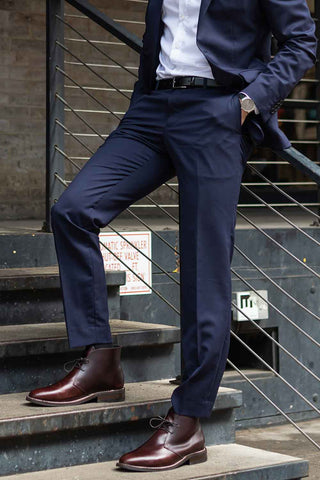
If pants are too short, it’s fairly obvious right away. Your biggest concern is likely if they’re too long. Depending on your personal style, you can choose the trouser break of your pants. The break is essentially how much, if any, fabric overlaps at the bottom of your pant leg. No break suit pants don’t have any fold at all, although it’s usually best to go with at least a slight break.
Pants with full breaks don’t look as formal or polished as those with a more mild break, so you may choose to avoid them depending on the occasion. You also have the option of a half or quarter break.
A subtle break flatters any body type, and it’s always on point, no matter the occasion. This is another easy fix for any tailor. Just ask them to hem the pants to your chosen style.

3. Seat of Dress Pants Should be Fitted
The seat of your pants is another important area to get fitted. Avoid pants with a lot of extra room in the seat so fabric doesn't get baggy or wrinkly. Of course, you don’t want them too tight either.
Typically, if the pants are too tight in the seat, you don’t even need to see it to know. You’ll be able to feel it if there’s too far on the snug side (although it never hurts to do a visual check, either).
If needed, move around a bit, sit down, get up, and see how it feels. If it squeezes too much while you’re moving around, you’ll need something a little bigger.
4. Find the Proper Waist Measurement
The fit of the waist gives a lot of guys trouble for a couple reasons. The first is that a lot of guys think of pants as pants, and have the waist of suit pants where jeans go. Unfortunately, this just isn’t how suit pants should fit. The waist is much higher, usually at least reaching to your upper hip measurement.
Of course, you can tell whether or not the waist fits pretty easily. It shouldn’t dig in, but it also shouldn’t leave huge gaps where fabric stretches out from your waist.
One of the best ways to double check the waist is just wearing the pants without a belt. Suit pants should fit so the waist is secure enough to hold up even without one. Here are also helpful guides on how to measure your waist for pants and how to measure pant length.
| Trouser Element | Correct Fit | Can a Tailor Fix It? |
|---|---|---|
| Waist | Upper hip — secure without a belt | ✓ Yes — waist adjustment is standard |
| Seat | Fitted — no excess fabric or sagging | ✓ Yes — seat can be taken in |
| Thighs | ~1 inch extra fabric each side | ✓ Yes — leg width is an easy adjustment |
| Break / length | Slight break or no break — not full break | ✓ Yes — hemming is the most common tailor fix |
The Proper Fit of Dress Shirts
While your dress shirt may not technically be part of your suit, you really can’t wear a suit without one. Not only that, your dress shirt is an accent point that works with your suit in your overall appearance. When you put it like that, you’d better make sure you know what a proper dress shirt fit is.

1. Fit on Torso
The body of your dress shirt covers your torso. While the suit jacket does cover some of this area, there’s still a lot that shows. If your dress shirt is too big, you’ll see extra fabric puffing out. There may be some looking baggy around the chest, but you can really tell at the waist. It’ll puff out, looking a bit like a muffin top.
You can usually feel it if a shirt hugs too tightly. Of course, your buttons feel the strain too, and that’s why fabric wrinkles out from the buttons if the shirt is too tight. You’ll often also see some pulling around the seams and shoulders.
We always recommend Nimble Made's slim fit dress shirt collection. They're one of the few men's shirt brands that fit in a true slim fit off-the-rack. For a more in-depth analysis, check out our article on modern vs slim fit.

2. Dress Shirt Length
Length can be a little tricky, but it’s not as hard as you think. Ideally, a perfect fitting dress shirt falls to just a few inches below where your belt would sit. If a shirt is too long, you’ll have extra fabric puffing up, or crumples in your pants from where it tucks in.
If a shirt is too short, it may be difficult to keep it properly tucked in throughout your activities. At the very least, a dress shirt should be long enough to fully cover, or fall below, your belt line.
Nimble Made is a dress shirt brand that has a slightly shortened shirt length for those looking for a slimmer fit or is shorter in height. Here's their fit guide which has sizes based on height and weight.

3. Shirt Shoulder & Seams
Shoulders for dress shirts, much like for suit jackets, should sit with the seam right at your shoulder where it slopes down. Again, much like with suit jackets, the armholes of your shirt should give you some room to move, but not too much.

4. Sleeves and Shirt Cuff
Your shirt sleeve shouldn’t pinch when you bend your arm, but they also shouldn’t be baggy enough to wrinkle over. You still have an inch or two of extra space if the sleeves fit properly, although most sleeves taper slightly as they near the shirt cuff.

Shirt cuffs should be just large enough to slip your hand through without unbuttoning them. The cuffs should hit right around where your hand joins with your wrist (where the more prominent bones are).
If you're looking at more formal cuffs, try french cuffs. Here's a whole guide on french cuffs if you're choosing between barrel cuffs vs french cuffs.
6. Shirt Collar and Neck Size
When it comes to dress shirts, achieving the right fit for the shirt collar and neck size is crucial for both comfort and style. The collar should fit snugly around the neck without feeling constricting or causing discomfort. To determine the correct collar size, measure around your neck just below the Adam's apple. Remember to leave a little room for ease of movement and to accommodate for collar shrinkage after laundering.
Ideally, you should be able to fit two fingers comfortably between your neck and the shirt collar when it is buttoned up. This ensures a proper balance between a snug fit and allowing for comfortable breathing and movement. Avoid collars that are too tight, as they can create an unflattering and uncomfortable appearance.
We have a separate guide for all the different collar types on men's shirts.
Remember, finding the right shirt collar and neck size is essential for a well-fitted dress shirt that complements your personal style while keeping you comfortable throughout the day. Don't hesitate to seek professional assistance if you're unsure about your collar size, as the right fit can make all the difference in your overall look.

(An example of what is a club collar on men's shirts.)
Where to Find Your Suit Size
Suit sizing is different from shirt or trouser sizing — it uses a single number that combines jacket chest measurement with a corresponding trouser waist. Here's where to find your size and what the numbers mean:
Where Is the Size Label on a Suit Jacket?
The size label on a suit jacket is typically sewn into the inside left breast pocket — open the pocket and look for a small label or tag on the inside lining. Some suits have the size stamped or embroidered directly onto the lining near the pocket. If you can't find a label, check the inside collar seam at the back of the neck.
How to Read a Suit Size
| Size Label | What It Means |
|---|---|
| 38R | 38-inch chest, Regular length — most common size designation |
| 38S | 38-inch chest, Short length — shorter jacket and sleeve length |
| 38L | 38-inch chest, Long length — longer jacket and sleeve length |
| Trouser waist | Typically 6 inches less than jacket chest — a 38R usually comes with 32-inch trousers |
| EU sizing (48, 50, 52) | European sizing — roughly subtract 10 from EU to get US/UK chest size (EU 48 ≈ US 38) |
How to Measure for a Suit
To find your correct suit size measure your chest at the widest point — usually across the nipple line — with a tape measure held level around your back. Round to the nearest even number. This gives you your jacket chest size. Your trouser size is typically your natural waist measurement (not your hip measurement where jeans sit). For a full measurement guide, use our suit size calculator or read our chest measurement guide and waist measurement guide
Suit Fit for Slim Men
Slim frames face a specific problem with off-the-rack suits — standard cuts are designed for average builds, which means slim men get excess fabric through the chest, waist, and trouser thighs even when the shoulders fit correctly. Here's what to prioritize:
| Element | What Slim Frames Should Look For |
|---|---|
| Jacket cut | Slim or tailored cut — avoid "classic" or "relaxed" fit labels which add significant volume through the torso |
| Shoulder fit | Structured shoulder is a slim man's friend — it adds breadth and visual width to narrow shoulders |
| Jacket suppression | Good waist suppression in a slim cut jacket creates an hourglass shape that reads as broader-shouldered |
| Trouser cut | Slim trouser with slight or no break — elongates the leg and creates a clean vertical line |
| Dress shirt underneath | Slim fit dress shirt is essential — excess shirt fabric bunches under the jacket and ruins the silhouette |
| Brands to consider | Suitsupply, Indochino, Banana Republic slim — all offer genuine slim cuts without requiring expensive tailoring |
The dress shirt underneath a suit is where slim frames lose the most ground — a well-fitted slim suit jacket over a boxy shirt creates bulk rather than eliminating it. Nimble Made's slim fit dress shirts are cut specifically for slim frames and sit flat under a jacket without bunching. See our dress shirt fit guide for what to look for.
What a Tailor Can and Can't Fix
Not all suit fit problems are worth fixing — some alterations are straightforward and inexpensive, others are costly enough that you'd be better off buying a different suit. Here's the practical guide:
| Alteration | Difficulty | Typical Cost | Worth Doing? |
|---|---|---|---|
| Hem trouser length | Easy | $10–$25 | ✓ Always — most common and essential alteration |
| Take in jacket body | Easy to moderate | $30–$60 | ✓ Yes — makes a loose jacket look tailored |
| Shorten jacket sleeves | Easy | $15–$40 | ✓ Yes — essential for proper shirt cuff exposure |
| Take in trouser waist | Easy | $15–$30 | ✓ Yes — standard fix for slightly-too-large trousers |
| Narrow trouser leg | Moderate | $20–$50 | ✓ Yes — effective for slim fit on standard cut trousers |
| Let out jacket body | Moderate — limited by seam allowance | $40–$80 | ⚠️ Sometimes — depends on available fabric in seams |
| Shorten jacket length | Difficult | $50–$100 | ⚠️ Only if jacket is significantly too long |
| Adjust shoulders | Very difficult | $100–$200+ | ❌ Rarely worth it — buy a different jacket instead |
| Raise armholes | Very difficult | $100–$200+ | ❌ Not worth it — structural change to entire jacket |
The practical rule: always get the shoulder fit right off the rack. Everything else is adjustable at reasonable cost. For more on tailoring decisions see our should I get my suit tailored guide.
The Important of a Well-Fitted Suit
As the saying goes, you don’t get a second chance to make a first impression. Of course, you might get a second chance to get to know someone, but you can’t change the image you gave off upon first meeting them.
In casual situations, it’s a lot easier to make a good impression based off of your personality alone. However, in pretty much any situation that requires a suit or other types of jackets, your appearance does a lot of that for you.
Suits aren’t for barbecues and casual summer parties. They’re an item reserved for semi-formal or formal dress codes -- sometimes business professional as well. It goes without saying that in these situations, a good first impression can be paramount to your success.
Wearing clothes that practically hang off you gives the impression of slackness, or at least someone that puts little effort into their attire. Of course, clothes that are too tight or small don’t do you any favors either.
A well tailored suit shows that you take pride in your efforts, and yourself. Not only that, it can show that you’re coordinated and meticulous.
Have you had the hem altered? Sleeves adjusted perfectly? Or is there a missing detail that could make or break your ensemble? Most employers, business associates, and even clients look to associate with detail and goal oriented people.
By paying attention to what may seem small, you can make a big difference in how people first perceive you and continue to do from there on.
People are naturally attracted to others that they see common traits they share. As another old saying goes, dress for the job you want, not the job you have. Well-fitted suits give a distinctly professional, confident appearance. If you want to impress, you need to dress the part.
Whether subconscious or conscious, a baggy outfit gives others the idea that you may lack confidence, since it hides so much of your form. Likewise, if a jacket is too tight it may give the opposite impression that you’re rather bombastic or quite showy. It could even mean you won’t invest in a new, properly fitted suit.
Even if you’re not confident in your male body type, having a well tailored suit or custom suits are an absolute necessity. You don’t have to swim in your clothes, or feel like your suit is swaddling you. You just need to work with your proportions and the way the suit fits your body.
The most important thing is to wear your suit. Don’t let it wear you. A perfectly fitted suit denotes appropriate shoulder seam placement, proper jacket length and sleeve length, as well as well-fitting trousers. You don’t want to distract from the important things you have to say because you show up in a poorly fitted suit.
Conclusion
For every guy that’s ever struggled with finding a well-fitted suit, you now have your answer. This guide has given you all the tools you need to look sharp, smart and at your very best with a proper fit. You won’t struggle with ill-fitting suits anymore.
Remember, these tips about how a suit should fit work for anyone, no matter how tall, short, thin or wide you are. Base everything off your own proportions, find a great tailor and you’re all set!
Frequently asked questions about how should a jacket suit fit
Where is the size on a suit jacket?
The size label on a suit jacket is sewn into the inside left breast pocket — open the pocket and look for a tag on the lining. Some suits have the size stamped directly on the inside lining near the pocket. If you can't find a label there, check the inside back collar seam. The size will typically read as a number followed by a letter — for example 38R meaning 38-inch chest, Regular length.
How do I know if my suit jacket fits?
Check five things: shoulder seams sit exactly at the edge of your shoulders (not drooping over your arm), the jacket length reaches mid-crotch or knuckle level, you can slide your hand under the lapel without pulling, the jacket sleeve shows about half an inch of shirt cuff, and the collar touches your shirt collar without a gap. If all five pass, the jacket fits. If the shoulders are wrong, that's the one problem a tailor can't fix cheaply — everything else is adjustable.
How should suit jacket shoulders fit?
The shoulder seam should sit exactly at the edge of your shoulder — the point where your shoulder slopes down into your arm. If the seam droops over your arm, the jacket is too wide. If it pulls or bunches, it's too narrow. Shoulders are the most important fit element to get right off the rack because they are expensive and difficult to alter later.
How do you know if a suit fits properly?
A properly fitting suit can be determined by checking if the jacket shoulders align with your natural shoulder line and if the trousers drape smoothly without excess fabric or sagging.
Is it better for a suit to be tight or loose?
A suit should neither be excessively tight nor loose, but rather fit snugly to your body without feeling restrictive, allowing for ease of movement while maintaining a tailored appearance.
What is the perfect fit for a mens suit?
The perfect fit for a men's suit is achieved when it contours to the wearer's body shape without being overly tight or loose, ensuring a sleek silhouette and allowing for comfortable movement.
Where should suit sleeves fall?
Suit sleeves should ideally fall at the base of the wrist bone, allowing for about half an inch (1.3 cm) of the shirt cuff to be visible beyond the jacket sleeve.
More Men's Suit & Formal Wear Guides
- Should I Get My Suit Tailored? — when tailoring is worth it and when to buy a new suit
- How to Buy a Suit — complete suit buying guide from scratch
- Types of Suits for Men — understanding suit styles and cuts
- Best Suit Colors for Men — which colors to own and when to wear them
- Blue Suit With Brown Shoes — the most versatile suit color combination
- Suit Without a Tie — when and how to wear a suit open collar
- How Should a Dress Shirt Fit — the shirt underneath matters as much as the suit
Comments (0)
Back to News